

Biz PhD Workshop · 4 & 5 August 2026 · Concept and keyboard
AI Tools for Business Research
Two days in which every session paired a short conceptual opening with work you did on your own laptop — and you left with a research companion that keeps learning from what you do.
Five sessions · Twelve teaching hours · Laptops open throughout
> Pull every mention of tariff exposure out of these twelve 10-Ks,
  tag each one by business segment, and give me a table I can merge
  on GVKEY. Show me the plan before you write anything.
Speakers

Speaker
Ms Shao Jiaqi
NUS Business School · Department of Accounting
A fourth-year PhD student in Accounting. Her research asks how prediction markets aggregate information — what a market’s prices reveal that surveys and analyst forecasts do not, how quickly they absorb news, and where that mechanism breaks down.

Speaker
Dr Shirley Jiexuan Wang
Nankai University · Assistant Professor
An alumna of the NUS Business PhD in Accounting, Class of 2022. Her research explores the intersection of big data, emerging technologies, and information in financial markets.
Coordinators — Professor Tien Foo Sing and Professor Lin Yupeng. Organised by the Dean's PhD and Research Office.
When and where
- Dates
- Tuesday 4 and Wednesday 5 August 2026
- Time
- 09:00 – 17:00 SGT, both days
- Venue
- NUS Business School, Biz 2 Building, Level 5, Seminar Room 05-11
- Format
- In person, hands on, laptops open. Five sessions, twelve teaching hours.
- Organiser
- Dean's PhD and Research Office, NUS Business School
- Materials
- Slides, practice kits, and the setup guide
- Questions
- jiaqishao@u.nus.edu
Introduction
Artificial intelligence is opening the door to a new era of business scholarship: one in which every researcher can be accompanied by a personalised team of intelligent agents.
Organised by the Dean's PhD and Research Office, this intensive two-day course was designed to help NUS Business School researchers step confidently into this new world. Through immersive, hands-on training, participants built their own AI research ecosystem and saw how agentic AI can transform every stage of the research pipeline.
Rather than mastering a single tool, participants learned how to cultivate an evolving research companion that learns from their daily work and grows alongside the rapidly advancing frontier of agentic AI.
What you can do afterwards
Four capabilities, each practised on your own machine during the two days.
- Operate Run an agentic coding assistant fluently — install it, manage permissions and cost, and steer it with plan mode and prompts that actually land.
- Apply Put it on real research chores: exploratory analysis, building a dataset from raw sources such as SEC EDGAR, debugging, and refactoring.
- Personalise Shape the setup around your own work with custom skills, subagents, and MCP integrations — and wire the agent into a Markdown knowledge base that compounds.
- Evaluate Use LLMs across the research pipeline while reasoning about bias, reproducibility, and research ethics — and know which failure each safeguard is for.
Who it was for
Open to graduate researchers in any business discipline — Accounting, Finance, Marketing, Management, Operations, Information Systems, Economics.
No prior programming experience was required. Session 1B is a from-zero primer: basic coding literacy, an intuition-level introduction to how these models work, and a guided check of your environment. Anyone already working in Python, R, or Stata treated that session as a setup-verification pass.
What we did assume
- Comfort working with research data — spreadsheets, CSVs, regressions.
- No machine-learning theory.
- A laptop you can install software on, and two accounts: a Claude Code subscription (or API access) and a GitHub account.
- A free Obsidian install for Session 3.
Working through it on your own? Start with the setup guide — 30 to 45 minutes — then take the five decks in order from the materials page. Each one is the deck used live in the room, speaker notes and all.
The five sessions
Twelve teaching hours across two days. Each session pairs a short conceptual opening with a practice you run yourself. The same field-experiment paper runs through Sessions 1B, 2, and 3, so the work compounds rather than restarting.
Running order is as delivered. Durations are the teaching blocks; breaks and meals sat between them.
Day one — Tuesday 4 August
-
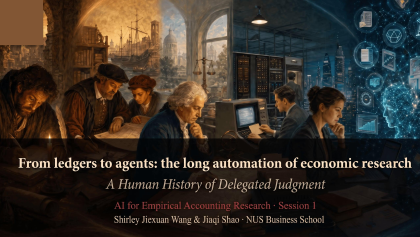
1A · From ledgers to agents
The long automation of economic research — a human history of delegated judgment.
Economists have been delegating judgment to machines for two centuries — ledgers, then regressions, then code. What changes when the machine starts writing the argument itself? This session traces that arc and then names the failures you will have to defend against: fabricated citations, results nobody can reproduce, and the AI-disclosure rules now in force at AEA, Elsevier, and Management Science.
-
Break
-
1B · Getting started with Claude Code
Coding basics and agentic systems — for researchers new to coding.
An agent will happily hand you a hundred lines of code you cannot check — and a number you cannot source. This session gives you the minimum to read it back: variables, loops, a CSV, a regression script, plus what an agentic system actually is and where its permissions and costs sit. You leave able to tell a working script from a merely plausible one.
Hands on · Practice A — set up, then understand the paper
-
Lunch
-
2 · Vibe coding with Claude Code
Two tasks, four rounds, one idea.
Two researchers use the same model on the same task; one gets a usable answer, the other gets nonsense. What differs is the harness — the tools, context, guardrails and checks wrapped around the model — and this session has you build one twice over, turning a paper into slides and then critiquing those slides. Two thirds of it is your keyboard, not the instructor's.
Slides — 112 pages, 995 KB PDF
Hands on · Practice B — paper to talk, then to referee
Day two — Wednesday 5 August
-
3 · Wiki LLM
Turn scattered papers into knowledge you can find and check.
You remember a paper's headline number but not what it was a percentage of — and the note that would tell you died in a folder you stopped opening. Every hand-kept research wiki dies of the same thing: not the reading, not the thinking, the bookkeeping. This session hands that upkeep to the agent — a plain-Markdown vault you own and version with Git, which it reads, searches and updates in place, so every answer names the table it came from.
Hands on · Practice C — make the paper compound
-
Break and lunch
-
4 · From filings to a structured database
Sixteen steps. You type all of them.
A policy shock you have already seen in prices — did it show up in what firms actually disclose? Over three hours you build the pipeline that answers it: a hundred 10-K risk-factor sections scraped, parsed and loaded into a database on your own laptop that you can query. Sixteen steps and three checkpoints, and you type all of them.
Hands on · the whole session is the build
How the workshop ran
A short course, not a for-credit course: no grades, no problem-set marks, no final project. What you got out of it was proportional to what you built during and between the sessions.
- Laptops open on both days, following along live.
- Everyone arrived with the setup already done, so no hour was lost to installing software.
- Participants brought a piece of their own data, or one research chore they wanted automated. The practices work far better on a problem you actually care about.
- Leaning on the assistant heavily is the entire point — while learning to verify what it hands back.
What participants said
From an anonymised written evaluation submitted after the pilot.
“Highly pragmatic, well-structured, and deeply relevant to the actual challenges I face in my daily academic workflows.”
A PhD participant, NUS Business School
“The course systematically deconstructed AI jargon, risks, and the true capabilities and limitations of these tools. It helped connect isolated pieces of information into a cohesive framework, allowing me to safely integrate AI into research.”
A PhD participant, NUS Business School
“Learning how to visualize code and markdown files within a single window eliminates the friction of constantly jumping between multiple applications, which will significantly streamline my research process.”
A PhD participant, NUS Business School