

AI Tools for Business Research · 4 & 5 August 2026
Materials
Everything used across the two days: the setup you do first, the five decks in running order, the three practice kits, and the resources worth keeping.
Start here
Budget 30 to 45 minutes for the environment. Participants did this before day one so that no teaching hour was lost to installing software; if you are working through the decks on your own, do it first for the same reason. The full walkthrough, including Windows and troubleshooting, is in the setup guide.
- Two accounts — a Claude Code subscription (or API access), and GitHub.
- A terminal — already installed on macOS; on Windows, install WSL
with
wsl --install. - Python 3.10 or later — check with
python3 --version. - Claude Code —
npm install -g @anthropic-ai/claude-code, then runclaudeonce and log in. - Obsidian — free, no account needed, for Session 3.
Then check it works
Make a scratch folder, start the agent, and ask it for something small:
> Create a file called hello.py that prints "ready for the workshop",
  then run it.
/exit.If it does not work, email jiaqishao@u.nus.edu with the exact error text.
Slides
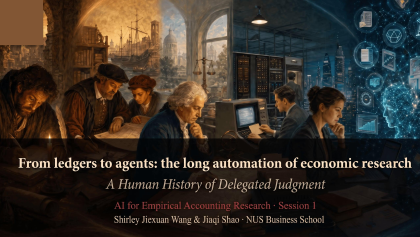
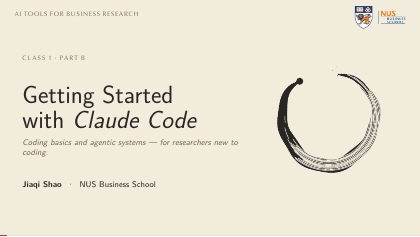
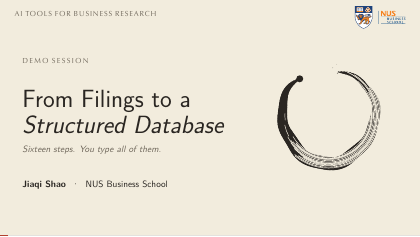
Five decks, in running order — each the deck used live in the room. Sessions 1B, 2, 3, and 4 are built with the house Beamer style, so the covers below are also a fair preview of what is inside.
| Session | Cover | Deck | Pages | Size |
|---|---|---|---|---|
| 1A | From ledgers to agents: the long automation of economic research Day 1 morning | 74 | 20 MB | |
| 1B | Getting started with Claude Code: coding basics and agentic systems Day 1 late morning | 60 | 242 KB | |
| 2 | Vibe coding with Claude Code: two tasks, four rounds, one idea Day 1 afternoon | 112 | 995 KB | |
| 3 | Wiki LLM: turn scattered papers into knowledge you can find and check Day 2 morning | 44 | 3.2 MB | |
| 4 | From filings to a structured database: sixteen steps, you type all of them Day 2 afternoon | 51 | 232 KB |


Practices
Three hands-on blocks, twenty minutes each, all on the same paper. They compound: A gets you a verified reading, B turns it into two deliverables, C turns it into knowledge that keeps paying back. Session 4 is a fourth hands-on block, but it is not a twenty-minute practice — the whole three hours is the build. Full instructions are in the practice guide.
The paper was handed out in the room. All three practices run on one field-experiment manuscript that is unpublished, so it is not distributed here. Everything else you need — the kit, the instructions, the slides — is on this page.
Install the kit first
Everything runs out of the setup kit — a
project memory file, a faithfulness rule, a house Beamer style, the
paper-to-slides skill, and a referee subagent. It is adapted from
Pedro Sant'Anna's public academic
workflow. From the folder holding the paper:
$ mkdir -p .claude
$ cp claude-setup/CLAUDE.md ./CLAUDE.md
$ cp -r claude-setup/{rules,skills,agents} .claude/
$ claude
/memory shows CLAUDE.md,
and /agents lists referee.A · Set up, then understand the paper
You have just met the agent; now put it on a real paper. You produce a working setup and a verified one-paragraph overview. Set up, five minutes; orient, eight; verify, six. The habit you keep for the rest of the workshop: never accept a number without naming the table it came from.
B · Paper to talk, then to referee
Two finished artifacts from one paper: present it fairly, then referee it fairly. You
produce a faithful talk deck and a referee report, using plan mode, the
paper-to-slides skill, and the referee subagent. The
instructor's demo is the target — yours need not match slide for slide, only fact for
fact.
> Plan a faithful conference talk from @RCT_paper.md using the
  paper-to-slides skill. Show me the slide outline before drafting.
C · Make the paper compound
A talk is used once; a wiki keeps paying back every time you return to the paper. You produce a mini LLM wiki — an index, a few pages, a log, then a lint pass. The raw source stays read-only; the agent maintains the knowledge pages. Next time you query the wiki instead of re-reading forty pages.
Going further
Tools and documentation
- Claude Code documentation — Anthropic.
- Model Context Protocol — the standard behind MCP servers.
- Claude Code: A Highly Agentic Coding Assistant — DeepLearning.AI short course.
- Obsidian help and community plugins.
- pedrohcgs/claude-code-my-workflow — a full academic Claude Code setup, and the lineage of the kit used here.
- Andrej Karpathy's notes — including the LLM-wiki gist quoted in Session 3, on why maintenance burden kills a knowledge base.
Data sources used or mentioned in the sessions
- SEC EDGAR full-text search — the source behind the Session 4 build.
- SRAF — Software Repository for Accounting and Finance (Loughran–McDonald) — sentiment and readability word lists, 10-X filing archives.
- Economic Policy Uncertainty — Baker, Bloom & Davis indices.
- Simon Oh's data page — cleaned research datasets and replication resources.
- WRDS — for the standard identifiers the extracted variables are linked to.
Papers worth reading alongside
- Gentzkow, Kelly & Taddy (2019). Text as Data. Journal of Economic Literature 57, 535–574.
- Korinek (2023). Generative AI for Economic Research: Use Cases and Implications for Economists. Journal of Economic Literature 61, 1281–1317.
- Roth, Sant'Anna, Bilinski & Poe (2023). What's Trending in Difference-in-Differences? Journal of Econometrics 235, 2218–2244.
- Hassan, Hollander, van Lent & Tahoun (2019). Firm-Level Political Risk: Measurement and Effects. Quarterly Journal of Economics 134, 2135–2202.
Journal policies on disclosing AI use
- AEA journals — editorial policy on AI and LLM use.
- Elsevier — generative AI in writing.
- Management Science / INFORMS — artificial intelligence policy.